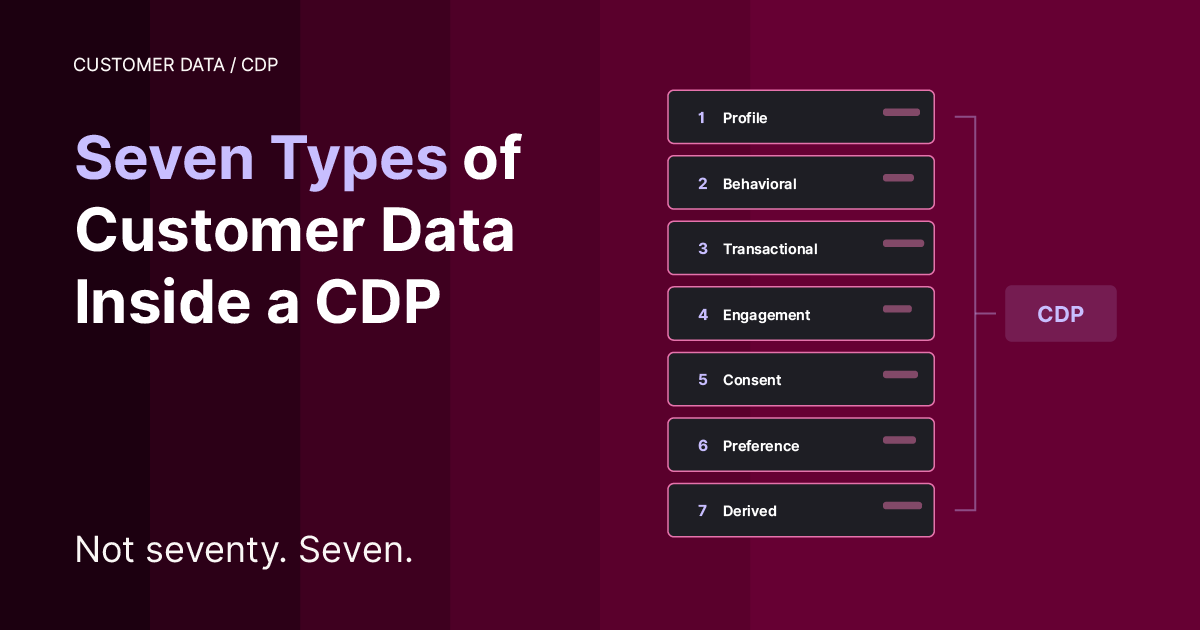
For practical CDP work, there are seven core types of customer data inside a CDP. Not seventy. Seven.
To get full value from your platform, you eventually need all seven. And you need the data in good shape.
Once you see this, the CDP starts making sense. And when something breaks, you know where to look.
Profile data
Who the customer is. Name, email, company, segment. Comes from your backend, databases, signup forms, CRM, support tools, loyalty programs, logins, product subscriptions. This is the identity layer. Everything else attaches to it. Get this wrong and everything downstream gets dirty, loses traction, loses value.
Without clean profile data, the single customer view becomes unreliable. Customer data unification turns into guesswork.
You will never get this to 100%. That is the nature of profile data. But the last few percentage points of identity quality often decide whether the CDP is useful or noisy. All other data connects to the profile, so it has to be paired correctly. No duplicates. No missing IDs. Even when your customer uses multiple devices, sometimes anonymously.
And it gets harder in layered services. Take telco. One ID is for billing. Another is the user. Another is household or service point. There are different services, at different locations, some paired or grouped, some not. Profile data sounds simple until you have to get it right.
Behavioral data
What the customer does. Page views, app events, searches, clicks. This is a real-time signal. It tells you someone looked at pricing three times this week but never clicked buy. Or someone is searching how to cancel the service. Or checking if the sport channel is included in their current package. Or checking if the room has a garden view. Or browsing for more brown high heels in your catalog.
Most teams collect this data. Few use it well.
This is as close as you get to reading your customer’s intent in real time. I am not saying it is easy. Seeing three page views does not tell you if your customer is fed up or in love. But it tells you something. Do not just collect it. Look at it. Listen. Get closer in small steps. Do not personalize beyond what the signal can honestly support. Adjust as you learn. That is what personalization is.
Transactional data
What the customer bought. Or wider. What the customer committed to. Orders, returns, subscriptions, payments, renewals, cancellations.
But look beyond e-commerce. What did the customer book? What did they reserve? What subscription did they renew? What service did they cancel? In insurance, when did the policy start and when did it lapse? In healthcare, when was the visit and what procedure was performed? Health and financial examples like these are sensitive: collecting and using this data depends on consent, a lawful basis, and sector regulation.
Every transaction is a moment with a business outcome. Someone bought, booked, paid, renewed, or walked away. That is what makes it transactional. If it is ongoing usage or a pattern over time, that is behavioral. If it is a response to something you offered, that is engagement.
This is where revenue lives. But on its own, it mostly tells you what already happened.
Engagement data
What you sent them and how they responded. Email opens, SMS clicks, push notifications delivered. This closes the loop between your campaigns and their behavior. Without it, you are guessing which messages work.
But engagement is not only about channels. It is also about what you offered. Was the upgrade even seen? Did the discount lead to anything? Was the retention offer accepted, ignored, or turned down?
Channel data tells you if you reached them. Engagement data tells you if what you put in front of them worked.
Consent data
What you are allowed to do. Opt-ins, opt-outs, consent records, legal basis. This is not a nice-to-have. Without this layer, the other six are a liability.
Straightforward in theory. But tightly connected to profile data in practice. You need to be sure that every action you take is lawful. That the consent tied to a profile is valid and current. And that there is no duplicate profile of the same customer sitting somewhere with a different, outdated consent status.
One thing worth separating: a preference center often collects consent and preference data at the same time. They look similar. They are not. “Unsubscribe from marketing emails” is consent. It is a legal boundary. “I’d rather hear from you by email” is preference. You should respect it, but ignoring it is often a customer-experience problem rather than a legal boundary, unless the preference is also used as a consent signal.
This is where identity problems become legal problems.
Preference data
What the customer says they want. Quiz answers, stated interests, communication choices. Not the same as profile. Profile says who they are. Preference says what they asked for. Explicit, high signal, and a reliable input for personalization.
When was the last time you asked your customers what they want? What they value? What they expect? Not guessing from signals. Not inferring from clicks. Asking.
In many cases, this is zero-party data. The foundation of every good relationship. Ask the other person how to make their life easier. Then act on it.
Derived data
What you calculated. Segments, scores, predictions, CLV, churn probability. Built from everything above. This is where the business value gets created. But it is only as good as the six layers feeding it.
Build a churn score on top of duplicate profiles and you get noise, not signal. The model looks confident. The output is wrong. Clean inputs first, then model.
There is also a trap in over-modeling. Teams build 30 segments and use 4. Calculate CLV but never trigger a campaign from it. The value of derived data is not in creating it. It is in acting on it.
And one thing worth noting: derived data is the only type that does not exist on its own. It is always computed from the other six. But it also feeds back into how you use them. A churn model tells you which profiles need attention. A purchase propensity score tells you which behavioral signals matter most. It is not just an output. It sharpens everything else.
Create what you can use. Stay curious. Optimize. Test. Start there and build from what you learn. The results will follow.
Together, these seven types form a practical core for most CDP data models. They are not just theory. They reflect how customer data is typically structured and used inside a customer data platform.
Everything else in a CDP describes the world around the customer. Product catalogs, store locations, currency, shipping zones. That is reference data, or what most teams call metadata. It gives context to events and transactions, but it is not customer data. Identity resolution is not a data type either. It is the logic that makes profile data work. Everything else is supporting context.
What to do with this
Map these seven types against your current setup. Where is the data clean? Where is it missing? Where is it collected but never used?
Most CDP problems are not platform problems. They are data problems hiding inside one of these seven layers. When you know which layer is broken, you know where to start.
This tells you what customer data is inside your CDP. But it does not tell you who collected it, or what rights you have. That is where first-party data strategy begins. It is a different question.
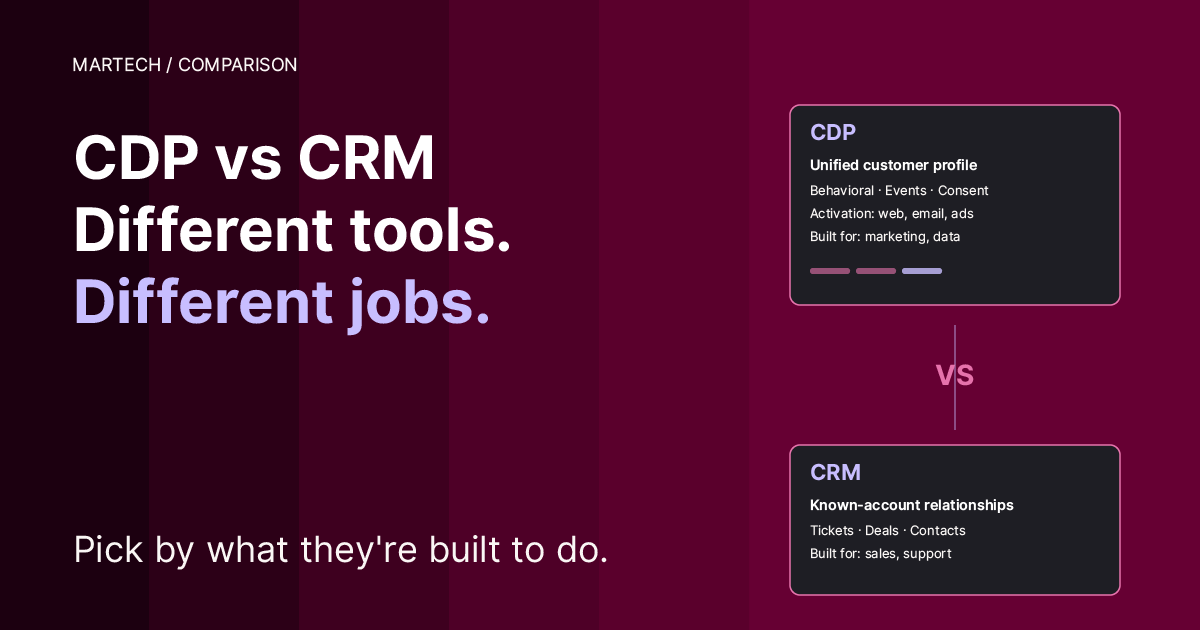
For the broader framing of where a CDP sits against a CRM, see CDP vs CRM in 2026. If you are still building the internal case for one, What Is a CDP for Managers is the shortest path to a shared vocabulary with your leadership.
Appendix: how the seven types show up across industries
E-commerce
Profile: customer account, name, email, address, loyalty tier
Behavioral: product views, searches, filters applied, cart adds, wishlist activity, price comparison page visits
Transactional: order placed, return processed, refund issued, subscription renewed, gift card redeemed
Engagement: opened abandoned cart email, clicked discount campaign, ignored restock notification, responded to review request
Consent: marketing opt-in, cookie preference, data sharing choice
Preference: “favorite size is 42,” “I want offers about running shoes,” “gift wrapping by default”
Derived: CLV, purchase frequency, predicted next order date, preferred category affinity
Retail
Profile: loyalty card, POS identity, household, in-store account
Behavioral: store visits, dwell time, in-app browsing, barcode scans, fitting room requests
Transactional: till receipt, click-and-collect pickup, in-store return, loyalty points earned, gift card purchased
Engagement: responded to loyalty promotion, used in-store coupon from email, ignored push notification about flash sale
Consent: marketing opt-in, location tracking permission, loyalty program terms
Preference: “preferred store is downtown,” “interested in organic products,” “no paper receipts”
Derived: basket analysis, cross-store shopping pattern, churn risk, household spend estimate
Banking
Profile: KYC data, verified identity, address, account type, segment
Behavioral: app logins, balance checks, feature usage, branch visits, mortgage calculator runs
Transactional: transfer completed, loan drawdown, card payment, account opened, account closed, standing order set up
Engagement: responded to credit card offer, opened rate change notification, clicked financial health nudge, ignored savings prompt
Consent: marketing consent, data sharing consent, regulatory consent
Preference: “preferred branch is city center,” “statements by email,” “no calls about insurance”
Derived: credit risk score, product propensity, lifetime value, fraud probability
Telecoms
Profile: billing entity, user ID, household, service point
Behavioral: data consumption, call frequency, roaming usage, app usage patterns, how often they check their balance
Transactional: contract signed, plan upgraded, device purchased, bill paid, service canceled, add-on activated
Engagement: responded to upsell offer, clicked retention campaign, accepted or declined a plan change you proposed
Consent: marketing consent, network analytics consent, location data consent
Preference: “I want paperless billing,” “do not call me with offers”
Derived: average monthly spend, churn risk score, household structure
Hospitality
Profile: guest record, name, contact, loyalty tier, travel document
Behavioral: browsing room types, checking availability for specific dates, looking at restaurant menus, searching “late checkout”
Transactional: room booked, stay completed, spa treatment purchased, minibar charged, cancelation processed, loyalty points redeemed
Engagement: opened pre-arrival email, responded to upgrade offer, left a review after a prompt
Consent: marketing consent, data sharing across properties in a chain
Preference: “high floor,” “garden view,” “extra pillows,” “early check-in when possible”
Derived: lifetime stays, average spend per visit, preferred property tier, rebooking likelihood
Fintech
Profile: onboarding data, verified identity, risk tier, account type, linked accounts
Behavioral: app usage frequency, feature adoption, portfolio checks, support chat initiated, comparison tool usage
Transactional: deposit made, withdrawal processed, investment executed, fee charged, subscription upgraded, payout completed
Engagement: responded to product recommendation, opened fee alert, clicked referral campaign, ignored educational content
Consent: regulatory consent, investment suitability, data sharing with partners
Preference: “weekly portfolio summary,” “notify me only above €500,” “risk appetite: moderate”
Derived: spending pattern, investment risk score, product fit prediction, upgrade likelihood
Travel / Airlines
Profile: passenger record, frequent flyer ID, travel document, tier status
Behavioral: route searches, fare comparisons, seat map views, app check-in frequency, destination browsing
Transactional: flight booked, upgrade purchased, ancillary added, cancelation processed, miles redeemed, lounge pass bought
Engagement: responded to fare alert, accepted rebooking offer, clicked disruption notification, ignored loyalty promotion
Consent: marketing consent, partner data sharing, location tracking
Preference: “aisle seat,” “vegetarian meal,” “morning departures,” “home airport is Vienna”
Derived: route loyalty, ancillary spend propensity, upgrade likelihood, disruption sensitivity
Insurance
Profile: policyholder identity, coverage type, risk profile, household structure
Behavioral: quote comparisons, policy document views, claims portal usage, app logins, coverage calculator runs
Transactional: policy purchased, policy renewed, policy lapsed, claim submitted, claim settled, payout completed
Engagement: responded to renewal reminder, opened cross-sell offer, clicked claims status update, ignored prevention tips
Consent: marketing consent, health data sharing, third-party assessments
Preference: “contact by email,” “monthly payment,” “no paper documents”
Derived: claims propensity, risk score, retention probability, cross-sell fit
The pattern
If there is a moment, an exchange, and a business record, it is transactional. If it is ongoing activity or a pattern, that is behavioral. If it is a response to something you initiated, that is engagement. If the customer stated it, that is preference.
Read next
Where Customer Data Comes From: Zero, First, Second, Third Party. The companion axis. Seven types tells you what the data is; this piece tells you who owns it.
What Is a CDP for Managers? A Practical Starter Pack. The platform context. The seven types describe what gets stored in the CDP this piece introduces.
Data Sanity: Keeping Your Marketing Data in Check. Keeping each of the seven types clean once you have them.
WRITTEN BY

Jan Sacha
Co-Founder · Bloomreach Consultant
Bloomreach Marketing consultant, in his third year at Asteroad running daily CDP and marketing automation work for European clients. Former Exponea enterprise consultant and CEO of Digiline.


Put these ideas to work.
If an article names a problem you are dealing with, tell us. We will listen first, then tell you honestly what we would do. No pitch, no commitment.