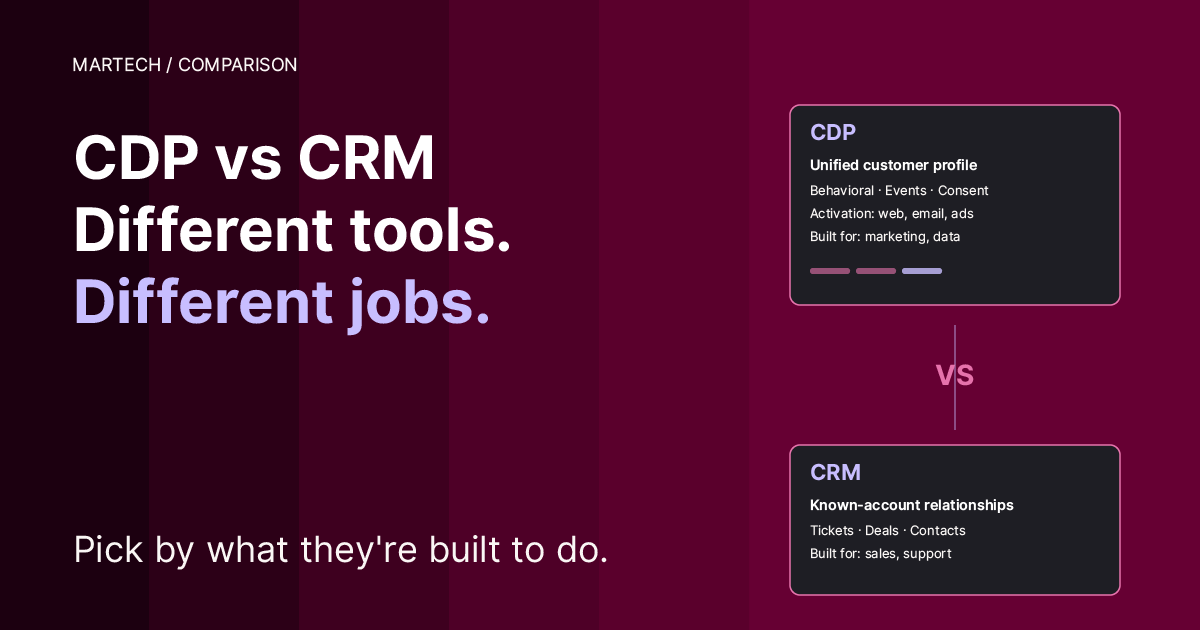
When someone says "CDP" or "CRM," many teams picture the same thing: a customer database.
The reality is more nuanced. A CDP solves the problem of data and identity across channels. A CRM solves the problem of processes and people working around the customer.
Once this distinction clicks, everything else falls into place.
Definitions Worth Agreeing On
A CDP, or Customer Data Platform, is, according to the CDP Institute, "packaged software that creates a persistent, unified customer database that is accessible to other systems." Gartner extends this definition by describing CDPs as platforms that "optimize the timing and targeting of messages, offers, and customer engagement activities."
CRM, or Customer Relationship Management, is, according to Gartner, a business strategy supported by technology for identifying and managing customer relationships. CRM software typically covers sales, marketing, customer service, and digital commerce.
The one-sentence summary: a CDP is about ensuring truth in your data. A CRM is about creating order in your work around the customer.
CDP: Core Principles
CDPs emerged because marketing and digital channels started producing massive amounts of signals scattered across silos: web analytics, mobile apps, email, ads, POS, call centers, loyalty programs, and events.
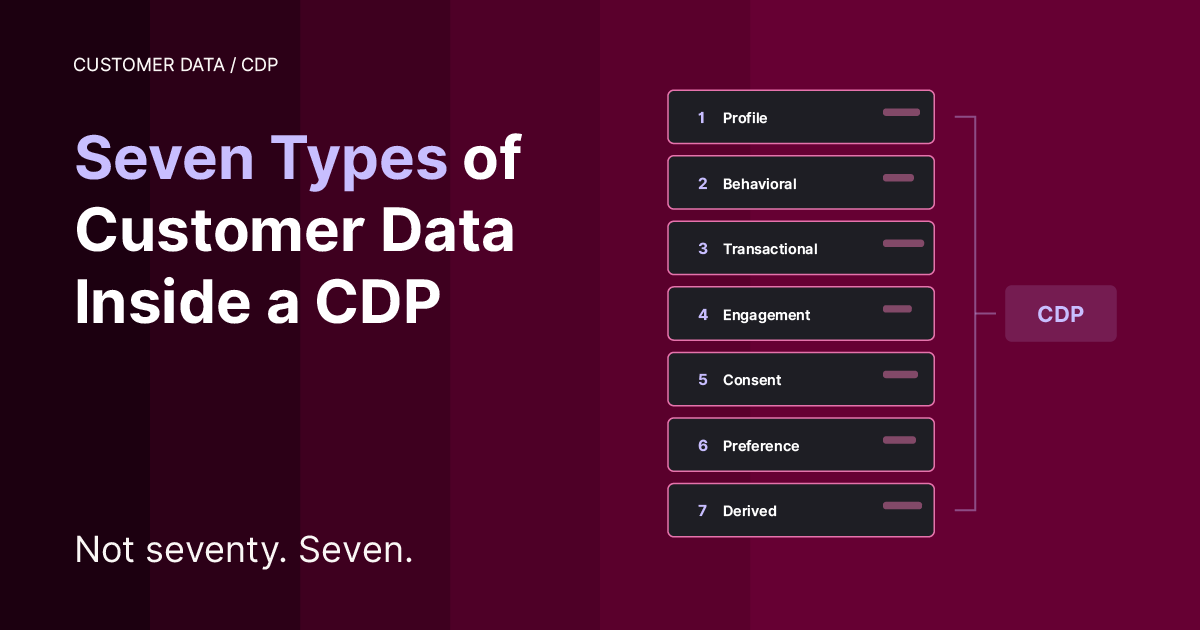
A CDP turns this chaos into one usable customer story. Those signals break down into seven types of customer data, and a CDP’s job is to hold all of them in one profile.
Unified customer profile across sources. Not just a contact record. A CDP links identities and events so teams can build segments, personalize experiences, and measure consistently.
Persistence and accessibility. A CDP only makes sense when its output can be consumed by other tools: marketing automation, ad platforms, web personalization, and analytics.
Activation and optimization. Gartner emphasizes timing and targeting. A CDP is not just about storing data; it’s about improving when, where, and to whom you send what.
CRM: Core Principles
CRMs emerged because companies needed to manage customer relationships and business processes consistently.
A CRM is where work gets done: leads, pipeline, activities, cases, SLAs, interaction history, and next steps.
Process truth. A CRM defines who handles what, in which state, and with what outcome.
Relationship context. A CRM stores interactions and the context of people’s work with customers. This enables follow-ups, pipeline management, request handling, and customer service improvement.
The Architectural Divide
A CDP is a data layer. It is where customer data gets unified, cleaned, identity-resolved, and prepared for use elsewhere.
A CRM is a workflow layer. It is where processes and cases are managed, and where people and automations execute concrete steps.
That’s why the distinction matters. A CRM may have a contact record and a few interaction events. A CDP has events across channels and can turn them into segments. A CRM excels at managing service and sales. A CDP excels at personalization and orchestration.
Dimension | CDP | CRM |
|---|---|---|
Core function | Unify customer data and activate it | Manage relationships and processes |
System role | System of intelligence and activation | System of engagement and action |
Data model | Person-centric, with identity resolution | Entity-centric: leads, accounts, cases |
Primary users | Marketing, data, analytics | Sales, service, support |
Output | Audiences, segments, triggers | Tasks, workflows, pipeline stages |
Value metric | Personalization lift, LTV, attribution | Win rate, CSAT, resolution time |
The 2026 Landscape: What Is Changing
CDPs Have Matured
Gartner has published a 2026 Magic Quadrant for Customer Data Platforms, a signal that the category is mature enough for standardized evaluation.
The market is increasingly focused on clear use cases and faster value delivery. CDP is no longer a marketing experiment. It’s becoming an infrastructure investment.
Composable and Warehouse-Native Approaches Are Mainstream
The CDP Institute describes a composable CDP as an approach that avoids creating new copies of data, taps into existing data warehouses, and gives companies greater control.
This is one of the biggest architectural debates in customer data today: classic all-in-one CDP versus warehouse-native, composable approaches where data stays governed in place and activation happens around it.
AI Agents Are Changing Expectations
Gartner predicts that 40% of enterprise applications will include task-specific AI agents by the end of 2026, up from less than 5% in 2025.
For CRM, this means more automation of work: summarization, recommendations, triage, and assisted workflows. For CDP, it raises the pressure on identity quality, governance, and real-time data availability. An AI agent without truthful data is just a confident hallucination.
Privacy and Data Clean Rooms Are Standard
Privacy-preserving collaboration is now a normal part of the stack. This pushes CDPs toward better identity management, data ownership, consent, and governance. It also pushes CRMs toward making operational data safely usable within the broader ecosystem.
When You Need What
You need a CDP when:
You want consistent personalization and segmentation across channels.
Your data is scattered across web, app, email, ads, POS, and service systems.
You need to optimize timing and targeting, not just store contacts.
You need a CRM when:
You need to manage pipeline, service cases, activities, and follow-ups.
You need a unified process for sales and service teams.
You need a system where the work around the customer happens.
In practice, most growing organizations need both. When you have more than one channel and more than one team, the CDP provides data truth and the CRM provides process truth. When they feed each other, the operating model becomes much stronger.
Common Misconceptions
"CDP replaces CRM." No. They solve different problems. A CDP unifies data across channels. A CRM manages workflows and relationships. Neither makes the other obsolete.
"CRM can do what CDP does." Only partially. A CRM stores known contacts and interaction history. It usually lacks real-time multi-channel identity resolution, probabilistic matching, and the ingestion layer a CDP provides. CRM vendors are adding CDP-like features, but their core architectures are still different.
"CDP is only for marketing." Increasingly false. Customer data unified in a CDP can feed analytics, product, finance, and AI decisioning, not just campaign targeting.
The Bottom Line
CDP and CRM are not competitors. They are tools for different problem categories.
A CRM helps a company work with customers consistently. A CDP helps a company understand customers across channels and activate data so marketing, digital, analytics, and adjacent teams can make better decisions.
In 2026, the boundaries are blurring as AI and composable architectures push everything toward better data and automation. But the core difference remains: CDP is about data; CRM is about process.
For leaders evaluating whether their organization needs a CDP, see What Is a CDP for Managers for the practical starter pack.
Sources
Appendix: Full Comparison of CDP vs CRM
The comparison below is based on the Gartner, CDP Institute, and Forrester definitions referenced throughout this article.
Dimension | CDP | CRM |
|---|---|---|
Core function | Unifies customer data and activates it across systems | Manages customer relationships and business processes |
System role | System of intelligence and activation | System of engagement and action |
Data model | Person-centric, with identity resolution across devices and channels | Entity-centric: leads, contacts, accounts, opportunities, cases |
Data sources | Web, app, email, ads, POS, IoT, third-party data, CRM itself | Sales calls, emails, service tickets, manual entry, ERP |
Data collection | Automated ingestion via APIs, SDKs, and integrations | Manual entry and operational system integrations |
Identity approach | Probabilistic and deterministic matching, device graphs, stitching | Known contacts, manual deduplication, merge rules |
Primary users | Marketing, data teams, analytics, growth | Sales, service, support, account management |
Real-time capability | Core requirement for personalization and decisioning | Usually secondary; batch and operational focus |
Output | Audiences, segments, profiles, triggers to external systems | Tasks, workflows, pipeline stages, case resolution |
Integration pattern | Ingests from many sources and activates to many destinations | Acts as a hub for workflows, with more limited outbound activation |
Governance focus | Consent management, privacy compliance, data quality at scale | Process compliance, role permissions, audit trails |
Value metric | Personalization lift, attribution accuracy, customer LTV | Pipeline velocity, win rate, CSAT, resolution time |
2026 trajectory | Composable architectures, warehouse-native models, AI decisioning | Agentic AI, embedded automation, platform consolidation |
Key insight: in mature organizations, the CDP feeds the CRM with enriched profiles and signals, and the CRM feeds the CDP with interaction history and outcomes. Neither replaces the other.
Read next
What Is a CDP for Managers? A Practical Starter Pack. The companion piece. Where this article explains the difference between CDP and CRM, that one explains what a CDP actually does for your team.
Seven Types of Customer Data Inside a CDP. What is actually stored once you have a CDP. Useful for picturing the data structure behind the comparison.
Where Customer Data Comes From: Zero, First, Second, Third Party. The ownership axis. Zero-, first-, second-, and third-party data is the other dimension the CDP/CRM split intersects with.
Capturing GA4 Client ID in Bloomreach Marketing (Engagement). Identity plumbing for joining CDP and analytics data, one of the cross-system patterns this article argues for.
WRITTEN BY

Jan Sacha
Co-Founder · Bloomreach Consultant
Bloomreach Marketing consultant, in his third year at Asteroad running daily CDP and marketing automation work for European clients. Former Exponea enterprise consultant and CEO of Digiline.


Put these ideas to work.
If an article names a problem you are dealing with, tell us. We will listen first, then tell you honestly what we would do. No pitch, no commitment.