
If you manage a team that interacts with customers, owns revenue, or influences marketing spend, this is for you.
Most managers first hear about CDPs during a vendor pitch or a strategy offsite. Someone drops the term "Customer Data Platform," and half the room nods while quietly wondering whether it is just another name for a CRM or a data warehouse. It is not. But the confusion is understandable. Vendors sell features, analysts sell categories, and consultants, myself included, have historically been better at communicating with each other than with the people who actually have to justify the investment.
This article is for managers. Not data engineers, not martech architects. If you lead marketing, e-commerce, CRM, growth, or digital operations, this is the piece I have wanted to write for five years, after implementing CDPs across banking, telecom, and retail companies in Europe.
The One-Sentence Version
A CDP collects customer data from every interaction your company has with the customer and consolidates it into a single, reliable profile you can act on.
That is it. The rest is detail.
Why Managers Should Care
You already have data. It sits in your CRM, analytics tool, email platform, ad accounts, loyalty system, app, and call center logs. The problem is not that data does not exist. The problem is that it does not agree.
Marketing sees one version of the customer. Sales sees another. Support sees a third. The loyalty team has its own numbers. When the CEO asks, “How many active customers do we have?” four departments give four different answers.
A CDP solves that. It creates a single source of truth about who your customer is, what they did, and where they are in their journey, in a way other systems can use. Not a static report. A living, connected profile.
What a CDP Actually Does
A CDP collects data from your website, mobile app, email, ads, point-of-sale systems, customer service, CRM, and any other touchpoint where customers interact with your business. These are your first-party sources: the systems and channels where the customer interacted with you directly.
The CDP then resolves identity. It figures out that the person who browsed your site on a phone, clicked an email on a laptop, and bought something in-store is the same human being. This is harder than it sounds, and it is often the highest-value capability, because it turns scattered touchpoints into a single customer story.
In one banking project, this meant connecting more than a million fragmented records into roughly 400,000 actual customers. The data was there all along. Nobody had stitched it together.
Once profiles are unified, the CDP makes them available to other systems in real time: your email tool, ad platform, web personalization engine, push notification service, and analytics environment. The value of a CDP is measured by what happens after the data is unified, not by the unification itself.
A CDP overlaps with other tools, so here is the clean mental model:
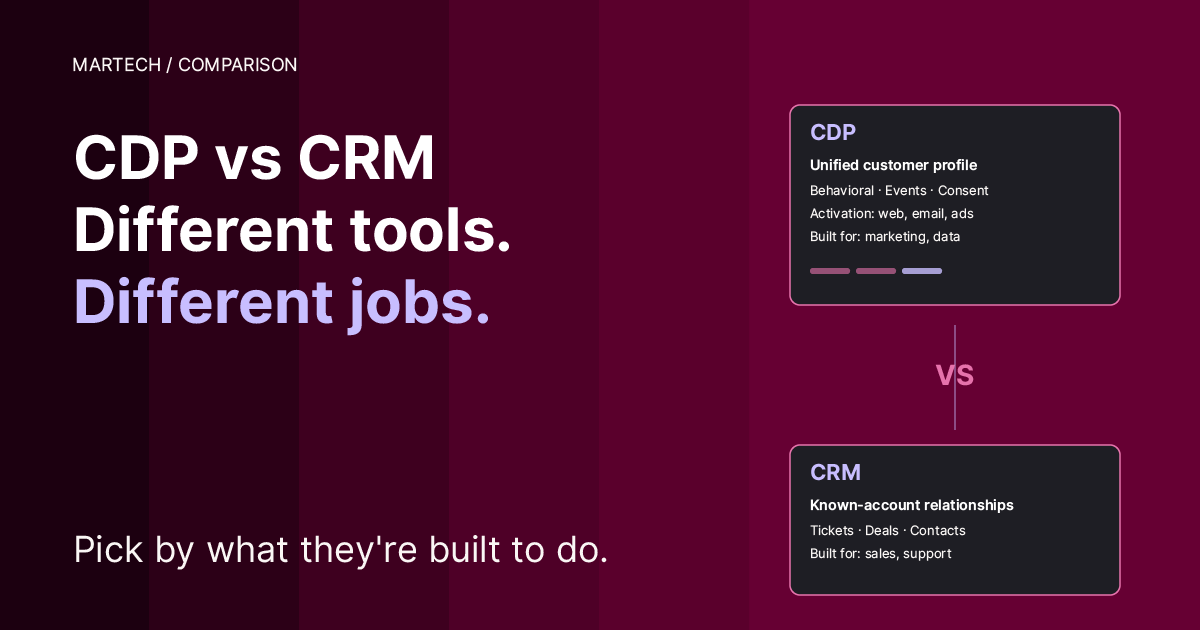
CRM: manages customer-facing work: sales pipeline, service cases, tasks, ownership, and follow-ups.
Data warehouse: stores data for analysis and history. It is excellent for BI, dashboards, and long-term reporting.
Marketing automation: runs campaigns and journeys: emails, pushes, workflows, and triggered messages.
CDP: unifies identity and behavior, builds audiences, and shares those audiences with the tools above so they act on the same customer truth.
If you buy a CDP expecting it to replace all of these, budgets get burned and teams get frustrated. The full CDP vs CRM comparison goes deeper.
What a CDP Changes for a Manager
Here is what changes in your day-to-day work when a CDP is properly implemented. The impact falls into three categories leadership already cares about: making better decisions, executing faster, and proving what worked.
Better Decisions
You stop guessing which customers matter most. When you can see the full customer story in one place (purchase history, service interactions, browsing behavior, and campaign responses), you can answer questions that used to require weeks of analyst time. What leads to repeat purchases? What causes churn? Which channels bring valuable customers, not just cheap clicks? Your retention strategy becomes based on actual behavior patterns, not last month’s spreadsheet. And you can defend your budget allocation with data your CFO is more likely to trust.
You see problems before they become losses. Unified behavioral data across channels lets you build early-warning signals. When a high-value customer stops opening emails, reduces purchase frequency, and visits your cancellation page, a CDP makes those signals visible in one place so teams can act before churn hits revenue. Without it, those signals sit in three different systems, and nobody connects them until the customer is already gone.
Faster Execution
You launch campaigns in days, not weeks. In most enterprises, the biggest bottleneck is not creative. It is getting the right audience list from IT. A CDP puts segmentation directly in the hands of marketing teams. In our implementations, campaign launch cycles routinely drop from weeks to days when segmentation moves from IT to marketing. That is not just a technology improvement. It is an organizational one. Marketing stops waiting, IT stops being a bottleneck, and both teams focus on what they are good at.
You personalize across channels without duct tape. Real omnichannel does not mean sending the same message everywhere. It means knowing that a customer browsed winter jackets on your website, did not buy, opened your app the next day, and should now see a relevant offer. Not a generic banner. Not a disconnected email. A relevant next step. A CDP enables this orchestration by sharing the unified profile with every activation tool in your stack and keeping that profile updated in real time. Without it, each channel operates on its own partial view of the customer.
Clear Measurement
You can actually prove what marketing spend produces. This is where most organizations struggle. A CDP connects upstream activity (campaigns, content, ads, and journeys) to downstream outcomes such as purchases, renewals, retention, and lifetime value. You can move beyond last-click reporting and measure contribution across touchpoints, as far as your tracking and consent allow. You can model customer acquisition cost against lifetime value with real data. That is the kind of analysis that turns marketing from a cost center into a growth argument.
The Foundation for What Comes Next
When your data is unified and clean, AI stops being a buzzword. Predictions, recommendations, lead scoring, churn scoring, automated next-best-action: none of these works meaningfully when your data lives in five disconnected systems. A CDP gives these capabilities a foundation.
In practice, this means automatically identifying which customers are most likely to churn next month and triggering a retention offer before they leave. Or scoring inbound leads based on behavioral patterns rather than job titles.
Without unified data underneath, AI in marketing is often just expensive noise.
When Does a CDP Make the Most Sense?
Not every company needs a CDP on day one. But the signs are consistent. Before any vendor conversation, run through this list:
Your customer data lives in five or more disconnected systems (CRM, email platform, e-commerce, analytics, customer service) and nobody has a unified view.
Your marketing team regularly waits on IT to pull audience segments, build reports, or connect data sources before they can launch anything.
You are investing in personalization but cannot prove it works, because attribution is fragmented and you cannot connect campaign activity to revenue outcomes.
You are facing growing privacy and consent complexity: GDPR, consent management, data subject requests, and manual handling across multiple tools.
You have outgrown your current stack. Your marketing automation tool or CRM is being stretched beyond what it was designed to do, and you are hitting walls on data volume, real-time processing, or cross-channel orchestration.
If three or more apply, a CDP conversation is worth having. If only one or two apply, you may get more value from fixing data integration or process alignment first. That is a less expensive and often more impactful starting point.
How a Manager Should Measure CDP Value
Most CDP projects fail in measurement, not technology. Teams measure success by how much data they loaded. That is not value. Value looks like business movement and operational speed:
Retention goes up.
Purchase frequency goes up.
Conversion goes up.
Customer acquisition cost goes down.
Wasted media spend goes down.
Campaign launch time goes down.
Share of identified users goes up.
Manual list-pulling and reporting effort goes down.
If your vendor or internal team cannot map the roadmap to two or three of these outcomes, pause the project and fix the plan.
The Honest Caveats
A few things marketing materials will not tell you.
A CDP is mostly about what surrounds the platform, not the platform itself. Before a single line of code runs, you need use case design, data architecture, identity resolution rules, naming conventions, and an event taxonomy. During implementation, you need alignment between marketing, IT, data, and business leadership on what “unified customer data” actually means for your company. After go-live, you need operating processes, data quality ownership, and people who know how to evolve the setup as the business changes. The CDP Institute’s 2024 member survey points in the same direction: the biggest adoption obstacle is not technical. It is organizational.
Implementation is not a project. It is an operating model. A CDP does not go live and run itself. Data quality degrades. New sources need to be integrated. Use cases evolve. People leave. If you are not budgeting for ongoing operations, you are buying an expensive database that will be outdated within a year. This is exactly why CDP projects fail in month four, not month one, as we cover in a companion piece.
“360-degree view of the customer” is a slogan. In practice, it is always a good-enough view for the decisions you need to make now. Push for specific use cases, not perfection.
“It will reduce IT dependency” is sometimes true. But often only after you invest in getting the data architecture right. In the early phase, IT involvement usually increases.
Real-time capability matters, but not always. If your use case is a daily email segment, you do not need sub-second data processing. If your use case is abandoned cart recovery within five minutes or real-time web personalization, you do. Know what you need before you buy.
You probably need fewer features than you think. The CDP market is consolidating. Platforms are absorbing adjacent capabilities such as analytics, orchestration, and AI. That gives you more options, and more ways to get it wrong. Start with two or three concrete use cases that solve real business problems. The organizations that try to boil the ocean on day one are the ones still arguing about data taxonomy twelve months later.
The Manager’s Punchline
A CDP makes sense when it reduces the chaos around customer data and enables faster decisions, faster execution, and clearer measurement of impact. It is not just a database. It is a management tool for controlling growth. When it works, the company moves from “we run campaigns” to “we have a system for working with customers.”
If you want to start with use cases instead of features, that is exactly how we work. No pitch deck, no feature demo. Just an honest conversation about where your data is, where it needs to be, and what it would take to get there.
Read next
CDP vs CRM in 2026. The companion piece. Where this article explains what a CDP does, that one positions it against the system most teams already have.
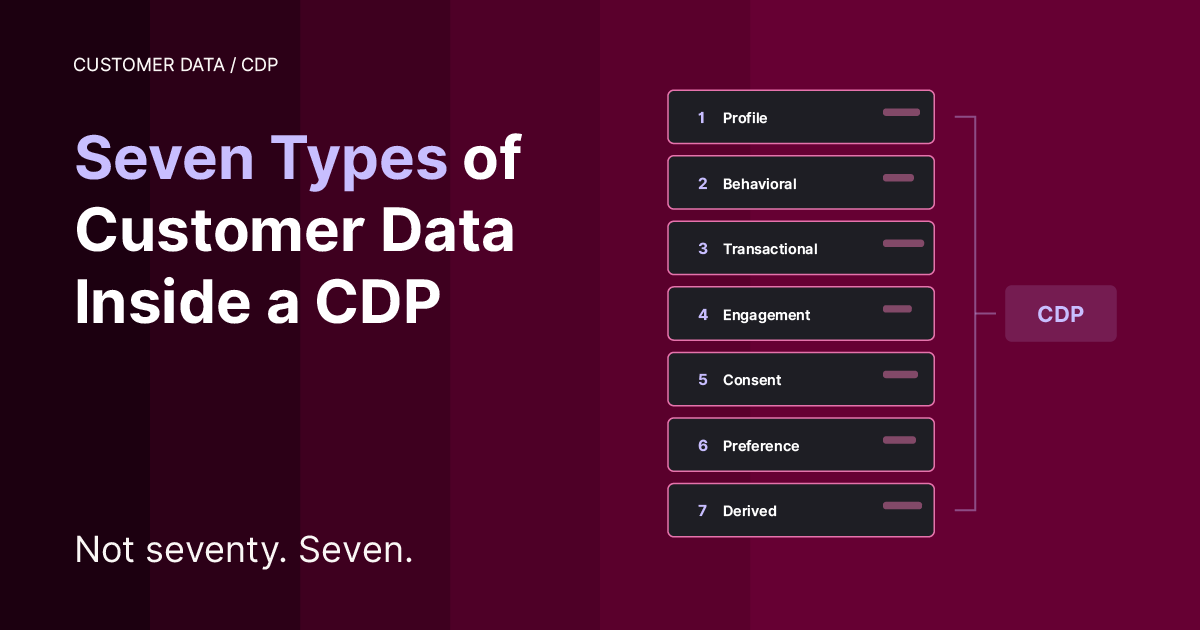
Seven Types of Customer Data Inside a CDP. What ends up inside a CDP once you have one. Use it to scope which data sources matter for your starter use cases.
Where Customer Data Comes From: Zero, First, Second, Third Party. Ownership labels for the data that flows into a CDP. The piece you will want when you start sourcing data for starter use cases.
Your Framer Cookie Banner Looks Compliant. It Isn’t.. The consent layer that governs which data flows into the CDP. A foundational operating decision before any campaign runs.
WRITTEN BY

Jan Sacha
Co-Founder · Bloomreach Consultant
Bloomreach Marketing consultant, in his third year at Asteroad running daily CDP and marketing automation work for European clients. Former Exponea enterprise consultant and CEO of Digiline.

Put these ideas to work.
If an article names a problem you are dealing with, tell us. We will listen first, then tell you honestly what we would do. No pitch, no commitment.