Stop Measuring Satisfaction. Start Engineering Emotional Loyalty
Here’s a question that will save you 10 minutes of reading if you answer it honestly: When was the last time a client told you, unprompted, no survey, no review cycle, that they wouldn’t go anywhere else?
If you can’t remember, you have a CX problem. And no, your NPS score doesn’t disprove that.
The drill problem
If you sell a drill, a car, or software, your competitor sells something almost identical at a similar price. Features converge. Prices converge. The only thing left that’s hard to copy is how it feels to be your client.
Most companies know this intellectually. Few act on it. Instead, they invest in CX with one goal: eliminate complaints. That’s not a strategy. That’s hygiene.
Your brain is a lazy archivist
Behavioral economics has a concept called the Peak-End Rule. Your brain doesn’t average the quality of every minute spent with a brand. It filters the experience into two snapshots: the most intense moment and the last moment.
Think about a hotel stay. The room was fine. Breakfast was good. But at checkout, the receptionist hands you a cold water bottle and says: “I noticed you’re heading out for a hike. Here’s a map with some shortcuts only locals know.”
That one gesture outweighs the fact that the pillow was too firm. That’s the moment you’ll come back for. Not the thread count. Not the breakfast buffet. The feeling that someone paid attention.
Research published in the Harvard Business Review found that emotionally connected clients are 52% more valuable than those who are just “highly satisfied.” Satisfaction is rational and temporary. Emotion is structural. It sticks.
The numbers, because you were going to ask
I know how this sounds in a boardroom. “Feelings” don’t have a line item. But here’s what does.
70% of customers abandon a brand after just two bad experiences. Two. Not twenty. Two.
Forrester’s 2025 Total Experience research found that companies aligning brand and customer experience can unlock up to 3.5x revenue growth.
CX is not soft. It’s the hardest metric to fake, which is why it works.
Solve problems before they exist
The old model waits for the client to call with a problem. The new model calls first. “Hello Mr. Smith, we see your flight is delayed. We’ve already pushed your car rental back by two hours.” That’s the moment a vendor becomes a partner.
This is where most companies fail. They have the data to do this. They have a CDP, a CRM, and real-time event streams. But the systems don’t talk to each other, the triggers aren’t configured, and the team doesn’t have the bandwidth to set it up. Proactive CX isn’t a mindset problem. It’s a plumbing problem.
Personalize beyond the first name
Using someone’s name in a mass email impresses no one in 2026. Real personalization is contextual. If a bank knows a client just bought a flight to Tokyo, send tips on ATM withdrawals abroad. Don’t pitch them a mortgage they already have. Kill the noise. Deliver value at the right time.
This only works when your data model is clean and your event taxonomy is right. If your platform can’t distinguish “booked a flight” from “browsed flights,” your personalization will always be either too generic or too creepy. We’ve seen this in almost every implementation we audit. The intent is right. The data underneath it isn’t.
Make technology invisible
Digital-first CX doesn’t mean replacing humans with chatbots. It means if I start a support claim in a chat and then call the hotline, the agent already knows what I wrote. The number one loyalty killer is making people repeat themselves.
The chat session, the call center CRM, and the customer profile need to sync within seconds. When they don’t, it’s usually because the integration was done once, for launch day, and nobody maintained it as systems changed.
The part nobody wants to hear
Most CX strategies fail not because the customer-facing layer is bad, but because the internal engine is broken. Employee experience is a prerequisite for client experience.
We’ve seen this play out firsthand with clients. A team running campaigns inside a platform they were never trained to use will default to batch-and-blast emails, regardless of what the segmentation tools can do. A CRM team with no autonomy to change a workflow without filing a ticket will stop trying to improve things. The tools are there. The freedom to use them isn’t.
You can’t expect someone bound by rigid scripts, with zero autonomy, to deliver empathy. If your team feels like replaceable parts, your clients will feel it too. Experiences worth remembering come from people who have the freedom, and the tools, to be human.
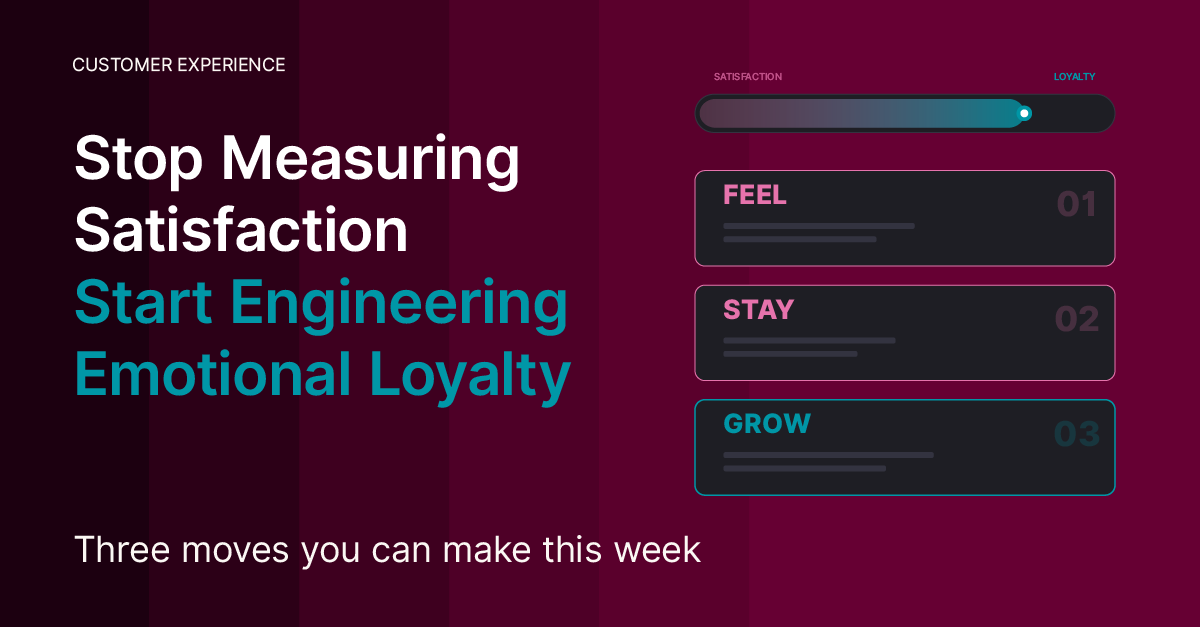
Three moves you can make this week
Pick one high-anxiety moment in your client journey and resolve it before the ticket arrives. A delayed shipment, a failed payment, an expiring contract. If you know it’s happening, tell them first. A delayed shipment has been detected in your OMS. Send an SMS before they check the tracking page.
Send one message that helps instead of sells. Based on something the client did, not something you want to push. If they just onboarded, send setup tips. If they just expanded, send a case study. No offer, no upsell, one link max: context, not campaigns.
Unify one support channel pair so context follows the client. Chat to phone. Email to in-app. Pick the pair that generates the most repeated explanations and fix that one first. Done means the agent sees the last message thread and the customer’s intent before they say hello.
None of this requires a new platform. It requires using what you already have with more intention.
So what now?
Companies that see clients only through the lens of quarterly revenue are heading for a wall. We see it in the data. Retention curves flatten, campaign engagement drops, and the response is usually to send more emails, not better ones.
Transforming CX is not a 12-month project with a neat deadline. It’s a continuous process. The question isn’t whether you can afford to invest in it. The question is whether you can afford not to, in a world where clients decide to leave after one bad experience, and execute that decision the moment switching becomes easy.
Because the competitor made them feel understood. That’s all it takes.