Identity resolution is the process of matching the many identifiers a single customer leaves across devices, sessions, and tools into one unified profile. It’s how a CDP decides that an anonymous web visitor, an email subscriber, and an app user are the same person.
Category
CDP Fundamentals, Customer Data
Also known as
identity stitching; identity matching
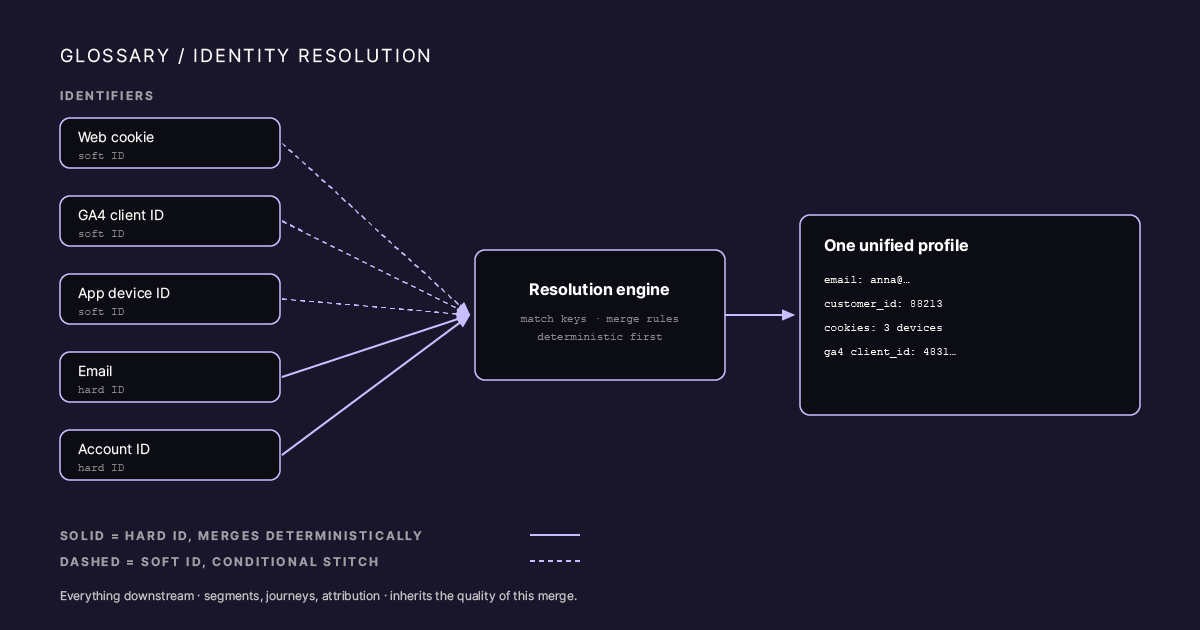
Multiple identifier tokens on the left (web cookie, GA4 client ID, email, account ID, app device ID) converging through a resolution engine into one unified profile card on the right. Hard IDs (email, account) draw solid Teal merge lines; soft IDs (cookie, GA4 client ID) draw dashed, conditional lines.
Example
A customer browses your site anonymously on their laptop, identified only by a cookie. A week later they log in on their phone with their email, a verified hard ID. They also have a GA4 client ID in each browser and your app installed.
Identity resolution stitches these together. The moment they log in, the hard ID lets the CDP merge the anonymous laptop history into the known profile, so the browsing from before login isn’t lost. What it cannot fully bridge on its own is a device switch: a GA4 client ID is browser-scoped, so without a shared login the laptop and phone sessions stay separate.
The payoff is scale. Fragmented records collapse to a much smaller set of real customers once identifiers are matched properly. The duplicates aren’t new people; they’re the same people seen through different identifiers.
Hard IDs vs soft IDs, and what each can stitch
The identifiers a CDP works with fall into tiers, and they don’t carry the same weight.
Hard IDs are verified and durable: email, account ID, phone number. A match on a hard ID is deterministic, so you can merge two records with confidence. Soft IDs are pseudonymous and fragile: cookies, the GA4 client ID, device identifiers. They’re useful within a browser or session but can’t be trusted to merge two people, because they’re lost on a device switch, a cookie clear, or a new browser.
Good resolution leans on hard IDs for the merges that matter and uses soft IDs to enrich, not to decide. Treating a soft ID as if it were a hard ID is how two different people get merged into one inaccurate profile.
Where it breaks
Identity resolution is often the highest-value capability in a CDP and the hardest to get right, and it fails in predictable places.
Cross-device without a login is the big one: if a customer never signs in, there’s no durable key to connect their phone and laptop, and soft IDs won’t safely bridge the gap. The second is conflicting sources. Each system (CRM, ecommerce, analytics, app) brings its own identifier and its own version of a field, so you have to decide which source is the source of truth for which attribute, and what happens when they disagree. Skip that decision, and the unified profile inherits contradictions from every system.
In practice
Treat identity resolution as a hard-ID-first problem: get the verified keys and the source-of-truth rules right, then let soft IDs enrich around them. If profiles are fragmenting or merging the wrong records, that ordering is usually where it went wrong.